Cupping for Chronic Tension and Lingering Pain
Fire and vacuum cupping in Silver Lake, Los Angeles. Releases deep tissue, increases circulation, and clears inflammatory markers to the surface.
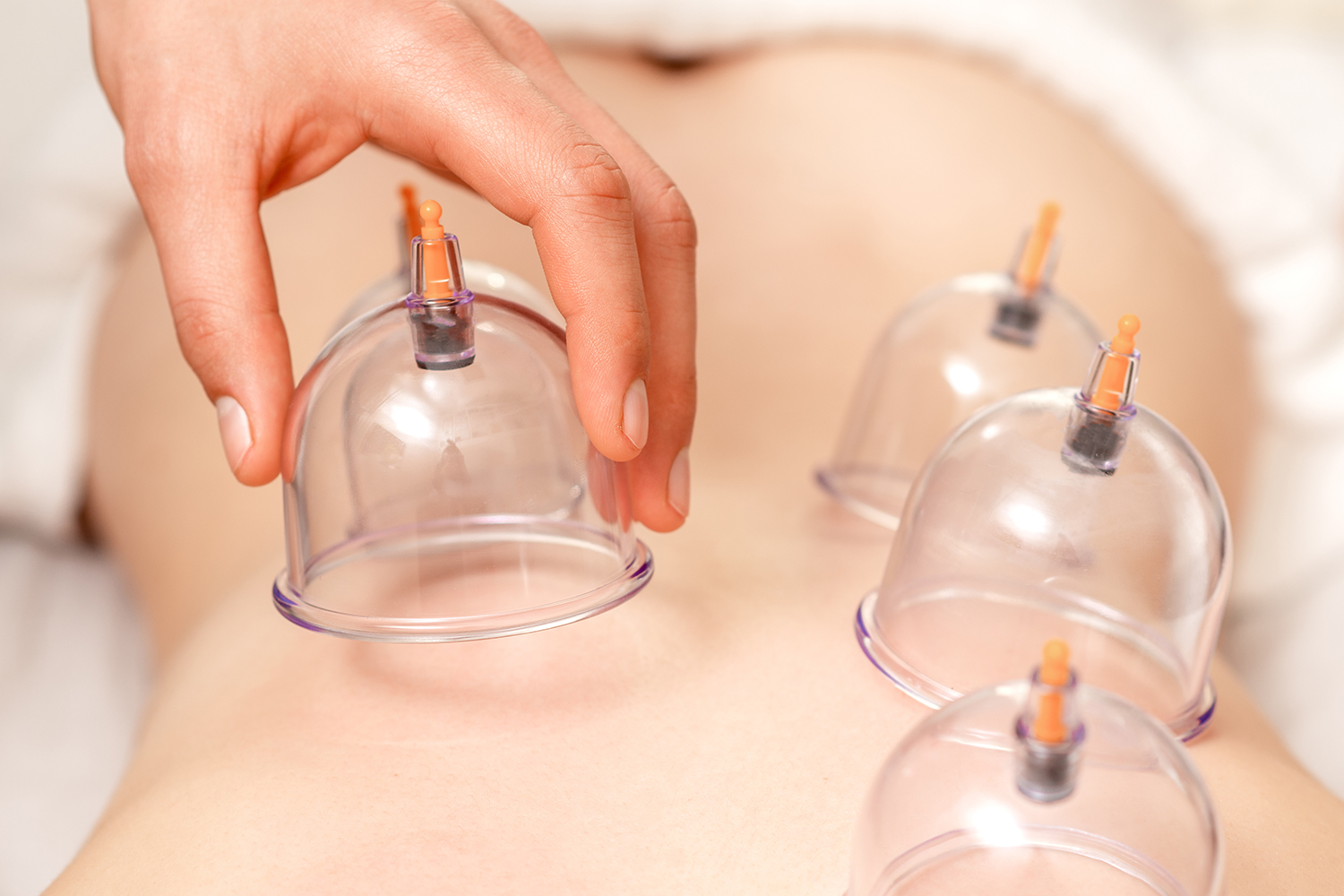
Suction that lifts tissue, instead of pressing on it.
Cupping is one of the oldest and most widely practiced forms of bodywork in the world, used across Chinese, Middle Eastern, and Eastern European medicine for centuries. The principle is simple: a cup placed on the skin creates gentle negative pressure that lifts the tissue beneath it, the exact opposite of the downward pressure of massage. That lift decompresses tight fascia and muscle, draws fresh blood into stagnant areas, and brings stale, inflammatory fluid toward the surface where the body can clear it.
In the clinic the cups may be glass, using a brief flame to create the vacuum, which never touches you, or silicone and plastic drawn down with a hand pump. They can be left stationary over a stubborn knot, or glided along an oiled muscle like an inverse deep-tissue stroke. The round marks people associate with cupping are not bruises. They are a temporary map of where circulation was most stagnant, and they fade within a few days.
Most often cupping is added to an acupuncture visit when a case has a strong musculoskeletal component, tight backs, locked shoulders, the residue of hard training or long hours at a desk. It reaches the kind of tension that needles and hands alone don’t, and the relief tends to outlast the marks by weeks.
This is one thread of our Silver Lake acupuncture practice. We bring it in when your pattern calls for it.
The mechanism, broken down.
The same suction, applied three ways, depending on whether your tension is local, widespread, or telling us something diagnostic.
Stationary cups
Cups are placed and left in position for 5–15 minutes for deep, focused release at specific points along the back, shoulders, or hips, exactly where a knot has settled in.
Sliding cupping
After a light application of oil, the cups are moved along the treated area, a kind of inverse deep-tissue massage that covers broader patterns of tension rather than a single point.
Diagnostic insight
The color and pattern of the marking tells us where circulation is stagnant and where it’s already flowing well, which informs the rest of your acupuncture protocol.
Common reasons patients use it.
Cupping is chosen when a case has a strong physical, tension-and-circulation component, the patterns that respond to having stuck tissue physically decompressed.
What you can expect from it.
Why it earns its place in a session.
Reaches what hands can’t
Suction lifts and separates tissue instead of pressing down on it, releasing deep fascia and adhesions that manual pressure tends to slide over.
Moves stagnant circulation
Drawing fresh blood into tight, under-perfused areas is what speeds recovery and eases the dull ache that lingers long after the obvious knot is gone.
Fast and surprisingly relaxing
A cupping block takes only minutes, and most patients describe the pulling sensation as deeply satisfying rather than painful.
Pairs naturally with acupuncture
Cupping and needles work the same channels from different angles, so combining them in a single visit compounds the result.
Is this right for you?
Cupping suits some bodies, and some weeks, better than others. The general picture:
A good fit if…
- You carry chronic tension in your back, shoulders, neck, or hips
- You train hard and want to speed recovery between sessions
- Your pain is the tight, stuck, “needs to be pried loose” kind
- Long hours at a desk have left you stiff and compressed
- You’d like a non-needle option, or to combine it with your acupuncture
Not the right tool if…
- You bruise very easily, take blood thinners, or have a clotting disorder, tell us first so we can adjust or skip it
- You have fragile or broken skin, active eczema, or a rash over the area
- You’re pregnant, certain positions and points are avoided
- You need the marks gone for an event in the next several days
Cupping marks are normal and harmless, but they are visible for a few days. If you have a wedding, a photoshoot, or a pool weekend coming up, let us know, we’ll place the cups where they won’t show, or save cupping for another visit.
Practical questions.
A first visit answers it.
An initial consultation of up to 90 minutes determines whether this modality is part of your plan, and what else might pair with it.